01
An online service that helps entrepreneurs globally to start a company in the UK
Barclays Business Banking
An online experience offering customers a simplified process to set up their business in the UK – providing a digital ID, company incorporation, tax registration, VAT registration and set up of relevant financial products all in one location.
UX Lead, 9 months, Contract with Sapient but worked client-side in Barclays
2 UX , 2 design,1 copywriter
Role:
Brief:
Tasks:
UX Management, Leadership, Requirements gathering, User research, Ideation, POC prototype, Discovery and vision, Strategy, Information Architecture, Responsive design, User testing, Multidisciplinary collaboration, Client workshop facilitation, Stakeholder engagement.
Summary
Overview
The task was to transform the current multi-site, multi-application company setup process into one simplified application, providing a single point of call, helping a budding entrepreneur to do everything they need to set up their business in one go. We had a group of Entrepreneurs who are actively engaged so we had the opportunity to continually explore and test at relevant stages.





Business Case

Who are the target customers?
The primary target customers are first-time entrepreneurs looking to set up a business and feel they are in need of information, guidance, and support. The secondary target customers are early-stage business owners that need help on how to grow their business.
How does this solution differ from the competition?
This online service is different to the existing process and will be an executional site where the customer can personalise their experience by adding tasks to their todo list or checklist. It will step the user through the full process and help them get their business up and running. It will provide one centralised location and a include a library of information and guidebooks that a user can add their personalised reading list.
Requirements gathering
Sketches, wireframes and prototype of key journeys
To ensure a seamless customer experience we need to make sure we are fully aligned with the businesses account opening work-stream so we can fulfil instant account opening to our customers.
We have already engaged fraud, legal and compliance and will be working closely with them throughout.
We will be partnering with both Companies House (for business incorporation) and HMRC (for registration of applicable taxes). This will allow for a joined up customer experience and afford excellent brand recognition as we are effectively receiving government endorsement for our service. In summary, this was quite a long process as there is so much legislation when dealing with the government bodies.
Validating the propositon
Insights were gathered from start-up businesses to understand their needs and formulate a service proposition.

A stronger proposition was created through a process of building and testing with users to ensure we designed a service that people need and want to use.
User research
First Hypothesis
The initial user research proved that the current process for setting up a business is noticeably fragmented, purely informative and it involves navigating a plethora of rules and regulations with multiple government bodies (HMRC, Companies House, etc).
Information is also often inaccurate and difficult to find.
Does not support the user's behaviour and timed interactions.
Overall the current experience is daunting and prevents entrepreneurs from progressing.


Second hypothesis
Our insights showed that along with entrepreneurs needing help setting up a business, early-stage businesses want support across a broad range of topics. These eight core areas were consistently mentioned.

Early concepts
Sketches, wireframes and prototype of key journeys


Personas
These were created to support the incubator workstream at Barclays and adapted to suit the needs of this project.


Storyboarding
High-level sketch of steps in flow

Proof of concept
At this stage, the high-level requirements were captured for the project so I could quickly sketch, wireframe, and prototype a solution to create a POC to test with our group of entrepreneurs. The purpose of this POC was to validate the second hypothesis before moving into an iterative UX, design and build process. It was received well by the entrepreneurs (primary and secondary target users) so we began the experience design process.


Key Customer Journeys
Mapped all the steps in the target customer journeys

Howard's Journey


Gabriella's Journey


Raki's Journey


Toby's Journey

Concepts, sketches, user journeys, wireframes, designs and prototype of key interactions and transitions, then test, iterate, create an XD specification, handover for development, QA Testing and refine.
UXD Agile Sprint Process
Each sprint we followed this process for the user stories that were assigned. It firstly involved analysis and exploration of each user stories, brainstorming, concepting, wireframing modules and templates, then visual design through to delivery of a built responsive fluid website.
Refining the concept and wireframes with the product owner and stakeholders. Sign off was required from the Product Owner. Verifying design direction with users in working focus groups that were provided for the business workstream.

XD Sprint Planning
I worked closely with the Product Owner and Business Analyst. Together we defined the scope and requirements. I then prepared the following sprint plans and then divided the work out amongst the team. A Kanban approach to UX and design was followed and worked well.


Sprint 0 - Discovery timing plan
Information Architecture
High-level sitemap
Planning the experience and Information Architecture (IA) in the master solution ensured efficient navigational structures and simplicity for all customer journeys.

Page flows
Different filters could be applied to the sitemap to illustrate things of interest such as the main page flows through the site. Mapping the user or page flows on the sitemap at this stage helped to assess what pages had priority in sprint plan and for MVP.

Navigation concepts
We followed a mobile-first approach and all team members sketched concepts and contributed to ideation.


Responsive navigation
Interaction design, functionality and transitions across all device types.
Mobile

Desktop


Tablet
Responsive wireframes
Patterns and behaviours were defined early in the process. Prototyping and testing key transitions proved very valuable.


UX Specification
Wireframes and a specification was heavily relived on in this process although it was Agile. The UX spec was needed tfor BA and the Product Owner to ensure all requirements were met, for compliance, Legal, development and QA.


Questionnaire


Designing the experience
Creating elements of delight to ensure an Exceptional Engaging Experience (EEE)
Home


Dashboard


The customer journey is simplified with just a path for a new customer or return customer
A typeform style questionnaire helps a user
to establish what they need to do to get
set up and this forms the user's checklist
All the items the user needs to complete are displayed on their dashboard, it indicates the length of time required for each item and allows the user to save progress
Company setup


Register for Tax and VAT


Accordion method to hide and show items lets users navigate around easily.
Easily register with all necessary government bodies.
Streamlined process


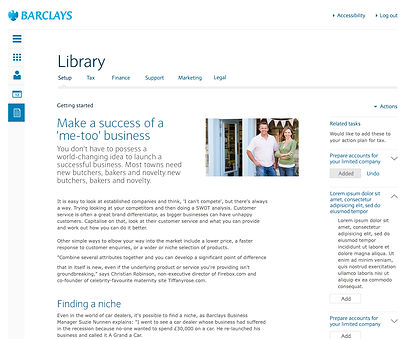
Library of helpful resources
.jpg)
Each flow was carefully analysed and we worked with the government to assess the need for every data field. This is how we could get a business up and running in a few simple steps.
Business insights and useful articles can all be added to a reading list that is saved to users profile to read when they got time.
UI Specification
This type of high-level visual spec was produced to notify the development team of design refinements and enhancements after user testing.


Responsive redesign,
platform migration
augmented reality feature
Working collaboratively and globally, I was part of a team that helped to deliver a multi-device, responsive redesign of Audi of America's website. The site was migrated from AEM to a new platform that used react and innovative technologies to enhance the customer expreience.
Client: AudiUSA
Role: Lead UX Designer, 6 months


